Introduction
There’s a particular kind of frustration that builds over time when you’re a serious coffee drinker paying for espresso drinks every single day. The math is straightforward — two or three specialty coffee shop visits a week adds up to a significant annual expense, and the quality, while often good, is entirely in someone else’s hands. You have no say in the grind, the extraction time, the milk temperature, or any of the other variables that determine whether your cup is genuinely exceptional or just acceptable.
That frustration is exactly where home espresso machines come in, and the Breville Barista Express occupies a specific and important position in that market. It’s built around a proposition that sounds simple but is actually quite considered — bringing the grinder and the espresso machine together in a single unit, removing the need for a separate grinder purchase while maintaining enough manual control over the process that the person using it can genuinely develop their technique over time.
Home espresso is a skill. There’s no getting around that. The difference between a mediocre shot and a genuinely beautiful one comes down to grind size, dose, distribution, tamping pressure, and extraction time — variables that require practice and attention to manage well. The Barista Express is designed for someone who wants to engage with that learning process rather than avoid it, who finds the craft of making good espresso interesting rather than inconvenient, and who is willing to invest the time to get better at it because the result — a genuinely excellent shot of espresso made at home — is worth the effort.
This article covers what the Breville Barista Express BES870XL offers, how its integrated system works, who it’s genuinely suited to, and what’s worth understanding before deciding whether it belongs in your kitchen.
What Is the Breville Barista Express BES870XL?
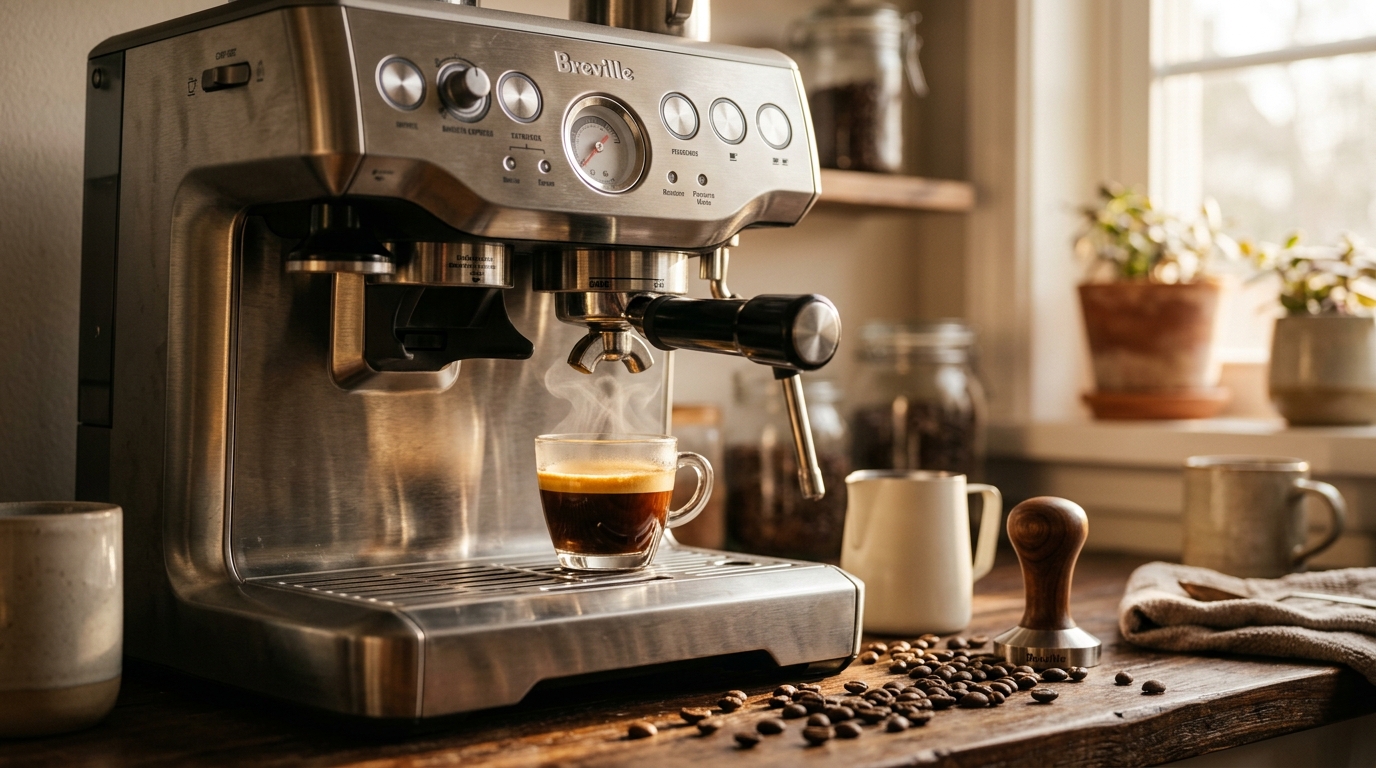
The BES870XL is a semi-automatic espresso machine with a built-in conical burr grinder, produced by Breville — an Australian brand with a strong presence in the premium kitchen appliance space, particularly in coffee equipment. The brushed stainless steel finish reflects the appliance’s positioning: serious equipment designed to last, with aesthetics that suit a kitchen where quality tools are valued.
The “semi-automatic” designation is important to understand. Unlike a fully automatic machine that handles dose, grind, extraction, and milk frothing at the press of a button, a semi-automatic machine requires the user to manage several steps manually — grinding the beans, dosing the portafilter, tamping, and controlling extraction timing. This hands-on involvement is not a limitation; for the right user it’s the entire point. It’s what allows genuine skill development and produces espresso quality that fully automatic machines at the same price point typically can’t match.
The BES870XL is designed specifically to lower the barrier to entry for semi-automatic espresso by integrating the grinder directly into the machine, reducing counter space requirements, and providing enough guided control that beginners can produce decent results while having room to improve significantly as their technique develops.
Key Features of the Breville Barista Express BES870XL
Integrated Conical Burr Grinder
The built-in grinder is the defining feature of the Barista Express and the element that most clearly distinguishes it from other semi-automatic machines at its price point. Grind quality is arguably the most important variable in espresso quality — the size, consistency, and freshness of the grind directly affect extraction. Grinding immediately before brewing, rather than using pre-ground coffee, produces noticeably better espresso because fresh grounds haven’t had time to stale and lose the volatile aromatic compounds that make espresso taste the way it should.
The conical burr design — two cone-shaped burrs, one fixed and one rotating — produces a more consistent particle size distribution than blade grinders, which chop coffee unevenly and produce a range of particle sizes that extract at different rates and produce muddied, inconsistent espresso.
The grinder on the Barista Express offers 16 grind size settings, from very fine to coarse, adjustable through a dial on the top of the machine. This range accommodates different bean types, roast levels, and personal extraction preferences, and getting the grind size right is the primary variable new users spend most of their initial learning time on.
Dose Control Grinding
Rather than grinding into a separate container and then transferring to the portafilter, the Barista Express grinds directly into the portafilter, which sits in a cradle below the grinder chute. A dose control dial determines how long the grinder runs — and therefore how much coffee is dispensed — which translates into the dose weight. Users adjust the grind time to reach their target dose, typically between 18 and 20 grams for a double shot.
This integrated workflow — beans in the hopper, portafilter in the cradle, grind directly into the portafilter — keeps the process clean and streamlined, and the inclusion of a built-in tamper mounted on the side of the machine means all the tools needed for the workflow are in one place.
15-Bar Pump Pressure
Espresso extraction requires significant pressure — industry standard is 9 bars during extraction, and the 15-bar pump on the Barista Express provides more than enough pressure to achieve and sustain that during a shot. The extra pressure capacity acts as a buffer, ensuring consistent extraction pressure even as the machine works against the resistance of a properly tamped puck of coffee.
The pressure gauge on the front of the machine displays real-time pressure during extraction, giving users visual feedback on whether their grind and tamp are producing the right resistance for proper extraction. A shot pulling in the under-extraction zone indicates the grind is too coarse or the tamp too light; a shot pulling in the over-extraction zone indicates the opposite. This visual feedback is genuinely educational and accelerates the learning curve for new espresso makers.
Pre-Infusion Function
Before full extraction pressure is applied, the Barista Express performs a pre-infusion step — gently saturating the coffee puck with low-pressure water for a few seconds before ramping to full extraction pressure. This pre-infusion allows the grounds to bloom and expand evenly before the full pressure hits, which improves extraction consistency, particularly with lighter roasts that have more retained CO2.
This is a feature more commonly found on machines at higher price points, and its inclusion in the Barista Express at its price tier is a meaningful detail for espresso quality.
Steam Wand for Milk Texturing
A pivoted steam wand produces the pressurized steam needed to texture milk for cappuccinos, lattes, flat whites, and other milk-based espresso drinks. Milk texturing — creating the silky, microfoam texture that allows for latte art and produces properly integrated espresso drinks — is a skill that takes time to develop. The steam wand on the Barista Express has enough power for proper milk texturing while being manageable enough for beginners to learn on.
Getting milk right requires practice. Angle, depth, and movement of the pitcher during steaming all affect the result, and the first attempts typically produce foam that’s too bubbly or milk that’s too hot rather than the smooth, glossy texture of properly steamed milk. This learning curve is real but surmountable with practice.
Hot Water Dispenser
Alongside the steam wand, the Barista Express includes a hot water outlet useful for preheating cups, preparing Americanos by adding hot water to espresso, or making tea. This is a standard inclusion on machines at this level and adds practical flexibility to what the appliance can produce beyond straight espresso.
Brushed Stainless Steel Construction
The brushed stainless steel exterior gives the BES870XL a substantial, professional look that holds up to daily handling. Stainless steel resists staining, wipes clean easily, and maintains its appearance through years of regular use in a way that plastic-heavy machines don’t. The aesthetic is clean and serious — this is a piece of equipment that looks like it means business.
Thermocoil Heating System
Rather than a traditional boiler that heats a reservoir of water, the Barista Express uses a thermocoil system — a coiled heating element that heats water as it passes through immediately before use. This produces faster heat-up times than traditional boiler systems, reaching brew temperature in roughly 30 seconds, and maintains consistent temperature throughout extraction without the wait associated with older boiler-based designs.
How the Breville Barista Express Can Be Used
Pulling Straight Espresso Shots
The foundational use case is pulling single or double shots of espresso directly into a demitasse. Grind the beans, dose the portafilter, distribute and tamp, lock the portafilter into the group head, start extraction, and watch the shot pull through in approximately 25 to 30 seconds for a properly calibrated double. The pressure gauge confirms extraction is happening in the right range.
Getting this right consistently takes time. The first week or two involves a lot of adjustment — grind size up, grind size down, tamp lighter, tamp firmer — as the feedback from each shot informs the next attempt. This iterative process is the learning curve of espresso, and the Barista Express provides enough feedback — the pressure gauge, the visual of the shot pulling, the taste of the result — to learn from each attempt effectively.
Cappuccinos and Lattes
After pulling a shot, the steam wand textures milk for milk-based drinks. A cappuccino uses roughly equal parts espresso, steamed milk, and foam in a small cup. A latte uses a larger proportion of milk — typically 6 to 8 ounces — to two shots of espresso, with a thin layer of microfoam. A flat white sits between the two, with less milk than a latte and more texture than an Americano.
The Barista Express handles all of these, and the steam wand provides enough power for proper microfoam once the technique is learned. Milk texturing is genuinely one of the more satisfying skills to develop — the moment properly textured milk pours into espresso in a clean white ribbon is one of the pleasures of home espresso that doesn’t get old.
Americanos
Adding hot water to a double shot of espresso produces an Americano — a longer, less concentrated espresso drink that some people prefer to straight espresso for everyday drinking. The hot water outlet makes this simple, and the resulting drink has a different character from drip coffee despite similar volume and strength — the espresso extraction process produces flavor compounds that drip brewing doesn’t, giving Americanos a distinct quality even when diluted.
Experimenting with Different Beans and Roast Levels
The 16-setting grind adjustment allows genuine experimentation with different coffee varieties and roast levels. Light roasts, which are denser and require finer grinds and longer extraction times, behave differently from dark roasts, which extract more quickly at coarser settings. Single-origin beans produce different flavor profiles than blends. Having a grinder that can be adjusted for each different coffee type encourages exploration and deepens understanding of how coffee variables affect espresso character.
Developing Barista Technique at Home
For coffee enthusiasts who want to genuinely understand espresso rather than just consume it, the Barista Express provides a platform for real skill development. Distribution techniques, different tamping approaches, adjusting dose weight, exploring different extraction ratios — these are all variables the machine allows the user to control and experiment with. Over months of regular use, the gap between early attempts and what becomes possible widens considerably.
Who the Breville Barista Express May Be Suitable For
Coffee Enthusiasts Ready to Learn
The Barista Express is not a machine for someone who wants to press a button and receive espresso without involvement. It’s for someone who finds the craft of making espresso genuinely interesting — who wants to understand why a shot tastes the way it does and how to make the next one better. For that person, it provides an ideal learning platform.
Daily Specialty Coffee Spenders
For households spending significant money on daily cafe espresso drinks — lattes, cappuccinos, flat whites — the Barista Express represents a break-even calculation that typically pays off within several months of daily home use. The upfront investment is real, but so is the ongoing cost of specialty coffee, and the home-made version, once the technique is developed, is genuinely comparable in quality.
Households That Value Kitchen Quality
The BES870XL’s brushed stainless construction, professional aesthetics, and build quality suit households that invest in quality kitchen equipment and expect it to last. This is not a disposable appliance — treated properly, it serves for many years of daily use.
People Who Already Own Quality Beans and a Grinder
Wait — the Barista Express has a grinder built in. But for households that already have a high-end standalone grinder and primarily want the espresso machine component, the integrated grinder is essentially unused capacity. In that scenario, a Breville machine without the built-in grinder at a lower price point might be a better fit. The Barista Express’s value proposition is strongest when the integrated grinder is the primary grinder in the household.
Apartment Dwellers Who Want Cafe Quality Without Separate Equipment
The integrated grinder is particularly valuable in apartments or smaller kitchens where counter space is limited and the prospect of both a separate espresso machine and a separate grinder is genuinely constraining. The Barista Express puts both in one footprint.
Important Things to Consider
The Learning Curve Is Real
This point deserves emphasis because it genuinely affects how satisfied first-time espresso machine owners are with their purchase. The first several weeks of owning a Barista Express involve a significant amount of experimentation and imperfect shots. Grind adjustments, dose adjustments, tamping consistency, milk texturing — none of these come naturally on the first attempt. For someone who expects to produce great espresso immediately, the learning curve will be frustrating. For someone who expects it and finds the experimentation interesting, it’s part of what makes the machine rewarding.
Bean Quality Matters Enormously
Espresso is an unforgiving preparation method — it concentrates everything in the coffee, including its flaws. Good beans reveal themselves as exceptional in espresso. Poor quality or stale beans reveal their weaknesses just as clearly. Sourcing fresh, quality coffee beans — ideally from a specialty roaster, roasted within the past two to three weeks — is as important to espresso quality as the equipment being used.
Grinder Adjustment Takes Time to Dial In
Each new bag of coffee may require grind adjustment. Different roast levels, different origins, and even different batches from the same roaster can require fine-tuning the grind setting on the Barista Express to achieve proper extraction. This is normal for any espresso setup and is part of why espresso making is a skill rather than a set-and-forget process.
Regular Cleaning and Maintenance Is Essential
An espresso machine that isn’t cleaned regularly develops coffee oil buildup that degrades both flavor and machine performance over time. The group head, portafilter, basket, and steam wand all require regular cleaning — daily wiping of the steam wand after every use, weekly backflushing of the group head, periodic descaling of the internal system. Building these maintenance habits from the start protects the investment and ensures consistent performance.
Counter Space Requirements
The Barista Express is not a compact appliance. It requires meaningful counter space, and its height means overhead cabinet clearance may be a consideration in some kitchens. The integrated grinder adds to the overall footprint compared to a machine without one, though it eliminates the need for a separate grinder alongside the machine.
Espresso Is Not the Same as Drip Coffee
This sounds obvious but has genuine practical implications. Espresso requires different beans (though any beans can technically be used), a different grind, different brewing parameters, and produces a different product than drip coffee. Households that primarily drink large volumes of drip-style coffee will find a dedicated espresso machine less useful in daily practice than households whose primary coffee preference is espresso and milk-based espresso drinks.
How the Breville Barista Express Compares to Other Options
Barista Express vs. Machine Plus Separate Grinder
A common alternative to the Barista Express is purchasing a dedicated espresso machine and a separate standalone grinder independently. A high-quality standalone grinder at a comparable price to the built-in grinder component of the Barista Express will often outperform it slightly in grind consistency and adjustment granularity. For serious espresso enthusiasts who want the absolute best grind quality, this route is worth considering. For households who want a capable, streamlined, space-efficient setup, the Barista Express’s integration makes more practical sense.
Barista Express vs. Fully Automatic Espresso Machines
Fully automatic machines — sometimes called super-automatics — handle the entire process at the push of a button. They grind, dose, tamp, extract, and sometimes even froth milk automatically. They’re convenient and consistent, but they remove the user from the process entirely, and at the same price point as the Barista Express, they typically produce espresso of somewhat lower quality due to compromises required in the automated workflow. For someone who specifically wants hands-off espresso, a fully automatic machine suits that preference. For someone who wants quality and the craft, the semi-automatic Barista Express is the better choice.
Barista Express vs. Pod Espresso Machines
Pod-based espresso machines — Nespresso being the most prominent example — produce consistent, fast, low-effort espresso-style coffee from proprietary pods. The espresso character they produce is genuinely different from properly extracted fresh-ground espresso — not worse, but different, and recognizably so to experienced palates. Pod machines are faster, simpler, and more consistent with zero learning curve. They cost less upfront but more per cup over time and don’t offer the same quality ceiling or skill development opportunities as the Barista Express.
Barista Express vs. Manual Espresso Makers
Manual lever-operated espresso machines place full pressure control in the user’s hands — you physically pull a lever to generate extraction pressure, giving complete control over the pressure profile during extraction. These machines represent the highest level of espresso craft involvement and can produce extraordinary results in skilled hands. They also have the steepest learning curve and least consistency for beginners. The Barista Express’s automated pressure generation produces more consistent results for users in earlier stages of developing their technique.
Frequently Asked Questions
How long does it take to heat up before use?
The Barista Express reaches brewing temperature in approximately 30 seconds thanks to its thermocoil heating system. This is significantly faster than traditional boiler-based machines that can take several minutes to stabilize, making it practical for everyday morning use without a long wait.
Can I use pre-ground coffee instead of whole beans?
Yes. The Barista Express includes a single-dose input on the grinder that allows pre-ground coffee to bypass the burrs and go directly into the portafilter. This is useful for decaffeinated coffee or specialty coffees purchased pre-ground, though grinding fresh beans produces better results for everyday use.
How fine should I grind for espresso?
Espresso requires a very fine grind — finer than drip coffee, coarser than Turkish coffee. The right grind setting varies depending on the specific beans, roast level, and your target extraction. Starting around setting 5 to 8 on the 16-setting dial and adjusting based on shot timing and taste is the recommended approach for beginning calibration.
How often does the machine need to be descaled?
Descaling frequency depends on water hardness and usage frequency. In areas with hard water and daily use, descaling every two to three months is typical. Breville includes water hardness test strips with the machine to help determine an appropriate descaling schedule.
Is the steam wand suitable for latte art?
With practice, yes. The steam wand produces milk with enough texture for basic latte art. Achieving the consistently smooth, glossy microfoam required for precise latte art takes dedicated practice — the wand has the capability, but the technique requires development time.
What size portafilter does the Barista Express use?
The Barista Express uses a 54mm portafilter, which is specific to Breville’s ecosystem rather than the more common 58mm commercial standard. This means third-party portafilter accessories and baskets need to be compatible with the 54mm size rather than standard commercial accessories.
How loud is the grinder?
The integrated conical burr grinder produces a moderate level of noise during operation — audible but not excessively loud. It’s quieter than many blade grinders and comparable to mid-range standalone burr grinders.
Does the machine require filtered water?
Using filtered water reduces mineral buildup and extends the time between descaling. It’s not strictly required, but it’s recommended particularly in areas with hard water, both for machine longevity and for taste — mineral-heavy water can affect espresso flavor.
Conclusion
The Breville Barista Express BES870XL sits in a genuinely distinctive position in the home espresso market. By integrating a capable conical burr grinder with a well-built semi-automatic espresso machine, it removes the biggest barrier to entry for serious home espresso — the need to invest in and manage two separate pieces of equipment — while preserving the manual control and skill development opportunity that makes semi-automatic espresso rewarding for people who care about coffee quality.
It is not a machine for everyone. The learning curve is real, the maintenance commitment is genuine, and the ongoing investment in quality fresh beans matters as much as the equipment itself. For someone who wants effortless, push-button espresso without involvement, there are better-suited machines in other categories.
But for the coffee enthusiast who finds the craft of espresso genuinely interesting, who is willing to spend the weeks it takes to develop consistent technique, and who wants to understand why a great shot tastes the way it does — the Barista Express provides a capable, well-designed platform for exactly that journey. The espresso it produces in skilled hands is genuinely excellent. Getting to that point is part of what makes owning it satisfying.